
Small Business Start Point — SBA, SBIR/STTR, DSIP & Army xTech
Turn an active SAM.gov registration, UEI, and CAGE code into a proposal-ready small business for federal set-asides and Defense SBIR/STTR opportunities.
Before you begin
You should already have an active SAM registration, UEI, CAGE, EIN, a legal business bank account, and accurate ownership records. Still forming the company? Start with Form your business entity.
Why this matters
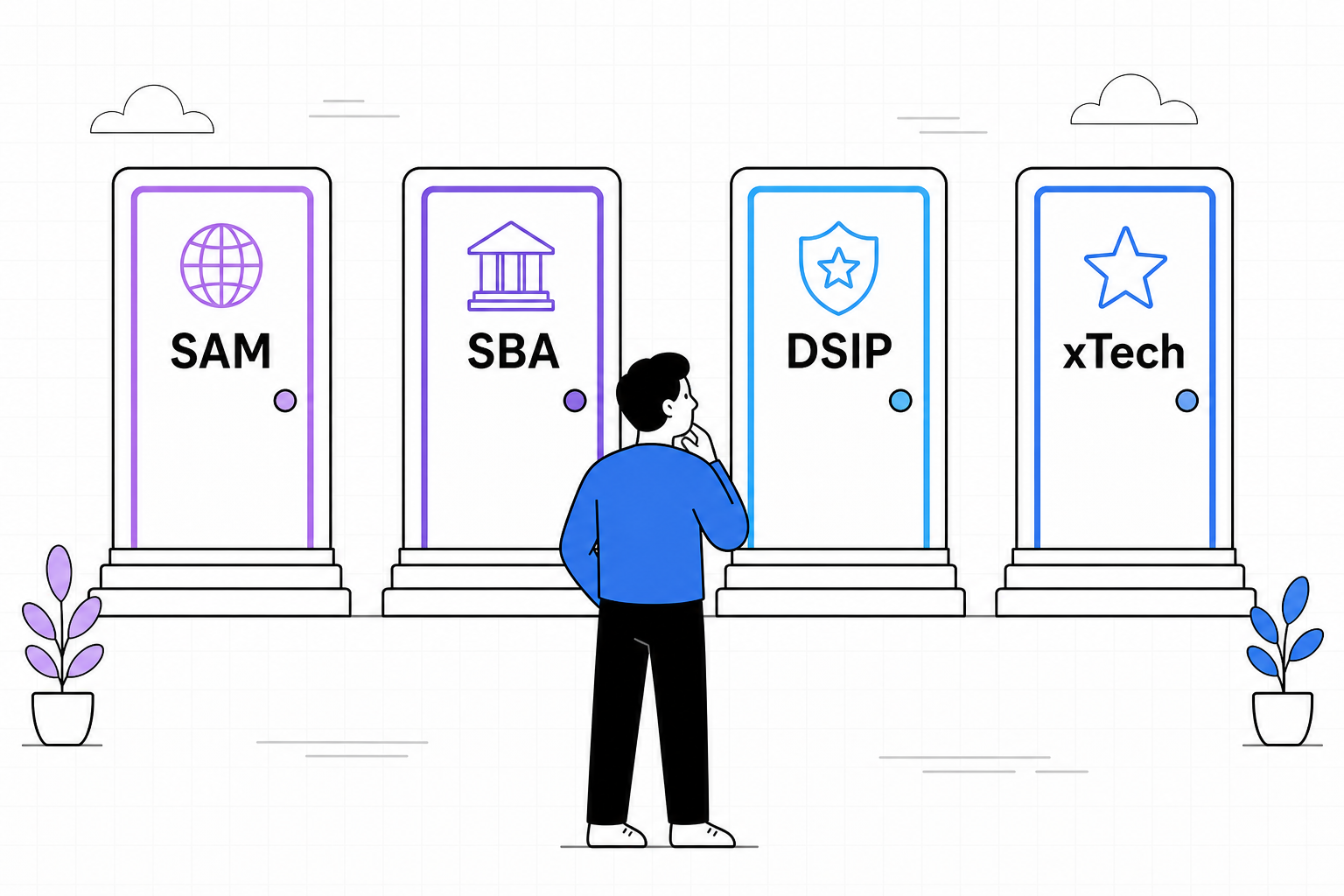
SAM.gov was the first door — not the last one. An active registration makes your company identifiable and awardable. It does not, by itself, confirm you are small for every opportunity, register you for SBIR/STTR, create your DSIP firm profile, certify you as 8(a)/HUBZone/WOSB/SDVOSB, submit you to Army xTech, or make your accounting and cybersecurity ready.
For Defense SBIR/STTR work, a company normally moves through three additional systems: SBIR.gov Company Registry (mandatory), DSIP (mandatory for full Defense proposals), and — for certain Army competitions — Army xTech and Valid Eval for the first round.
The complete starting path
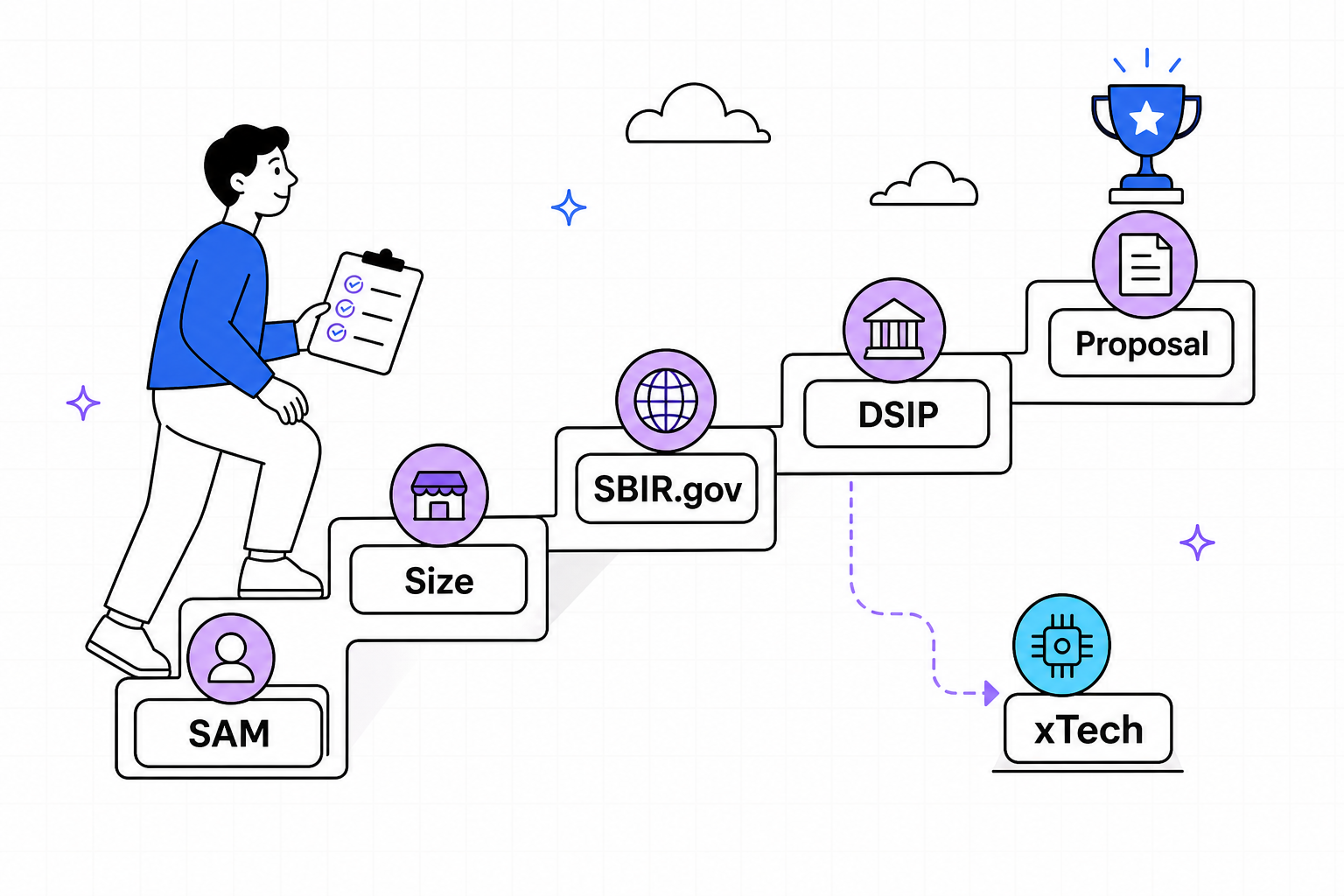
- 1Active SAM.gov registration
UEI + CAGE code in place — the foundation from the prerequisite module.
- 2Verify small-business and SBIR/STTR eligibility
Size under applicable rules, plus the SBIR 500-employee / ownership / U.S. work tests.
- 3Register on SBIR.gov
Receive the SBC Control ID and downloadable registration proof; refresh at least every six months.
- 4Optional certifications + Small Business Search
Evaluate MySBA programs only when they fit strategy; build a discoverable SBS profile.
- 5Set up DSIP
Login.gov accounts, firm record matching SAM, Firm PIN, roles, and firm-level forms.
- 6Find and read a Defense topic
Program BAA/CSO, component instructions, topic, amendments, and Q&A — in that hierarchy.
- 7Build and submit all DSIP volumes
Corporate Official certifies. Then selection, foreign-risk review, negotiation, and possible award.
What “small” means — and the SBIR test
For ordinary federal contracts, whether you are small depends on the solicitation’s NAICS code and the matching SBA size standard (average receipts, employees, and affiliates). You can be small under one NAICS and not another. Control can create affiliation even below 50% ownership.
SBIR/STTR uses a special eligibility test. A typical eligible firm is organized for profit, has a U.S. place of business, has no more than 500 employees including affiliates, meets U.S. ownership and control rules, performs the required R&D in the United States, and meets principal investigator and workshare rules. Venture-backed and institutionally funded companies need extra care — never assume a cap table is automatically eligible.
- Exact legal name, DBA, physical address, UEI, CAGE, EIN
- State and date of formation; ownership percentages; current capitalization table
- Board members, control rights, parents, and affiliates
- Employee count including affiliates; primary and secondary NAICS
- Principal investigator and government / company points of contact
Four SBA-related functions — do not conflate them
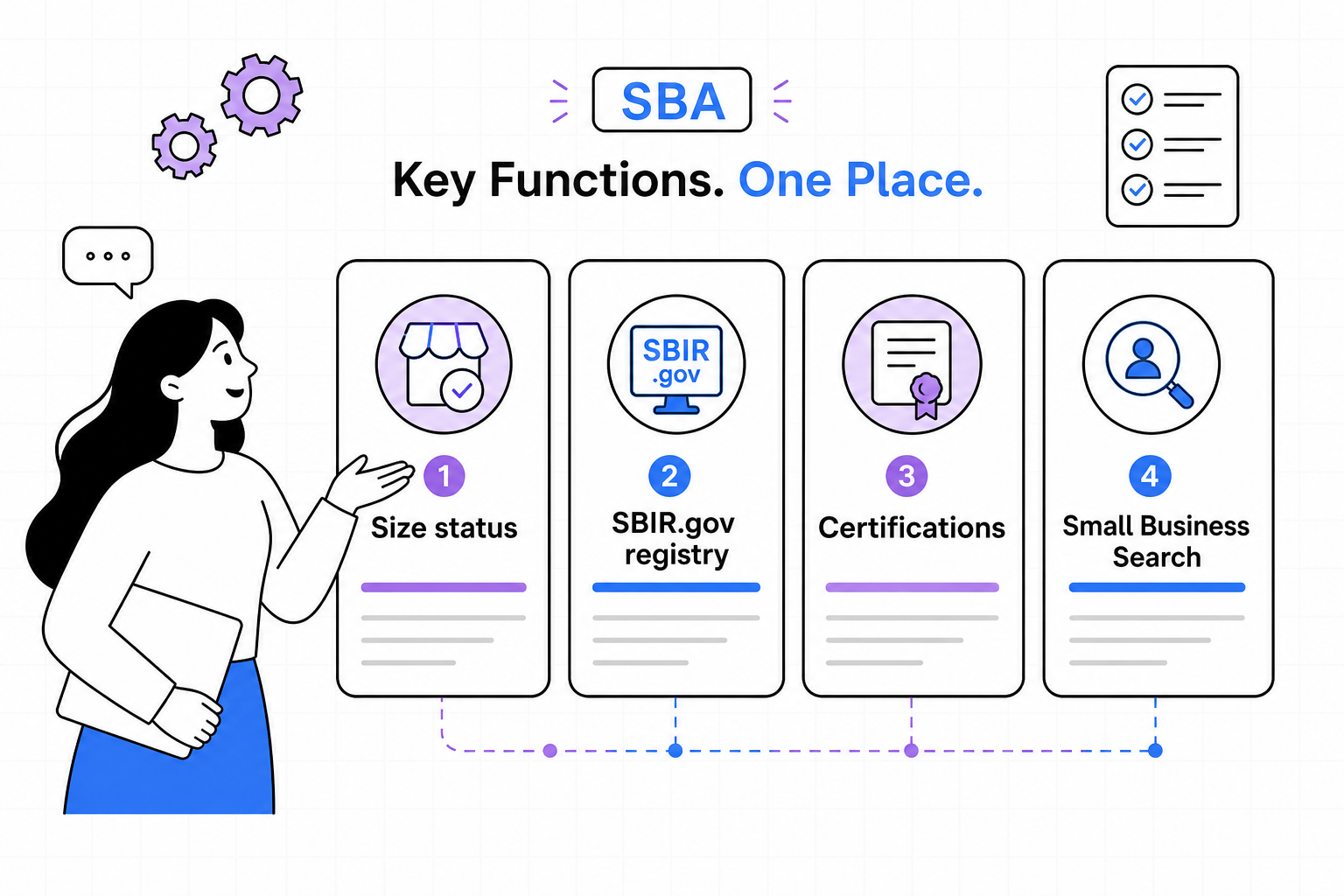
| SBA function | What it does | Required for Defense SBIR? |
|---|---|---|
| SBA size status | Determines whether the company is small under the applicable rules | Yes |
| SBIR.gov Company Registry | Issues the SBC Control ID and proof of registration | Yes |
| MySBA Certifications | Processes 8(a), HUBZone, WOSB/EDWOSB, and VOSB/SDVOSB applications | No — unless pursuing a separate program-specific opportunity |
| Small Business Search | Makes the company discoverable for agency and prime market research | No — strongly recommended |
Register in the SBIR.gov Company Registry
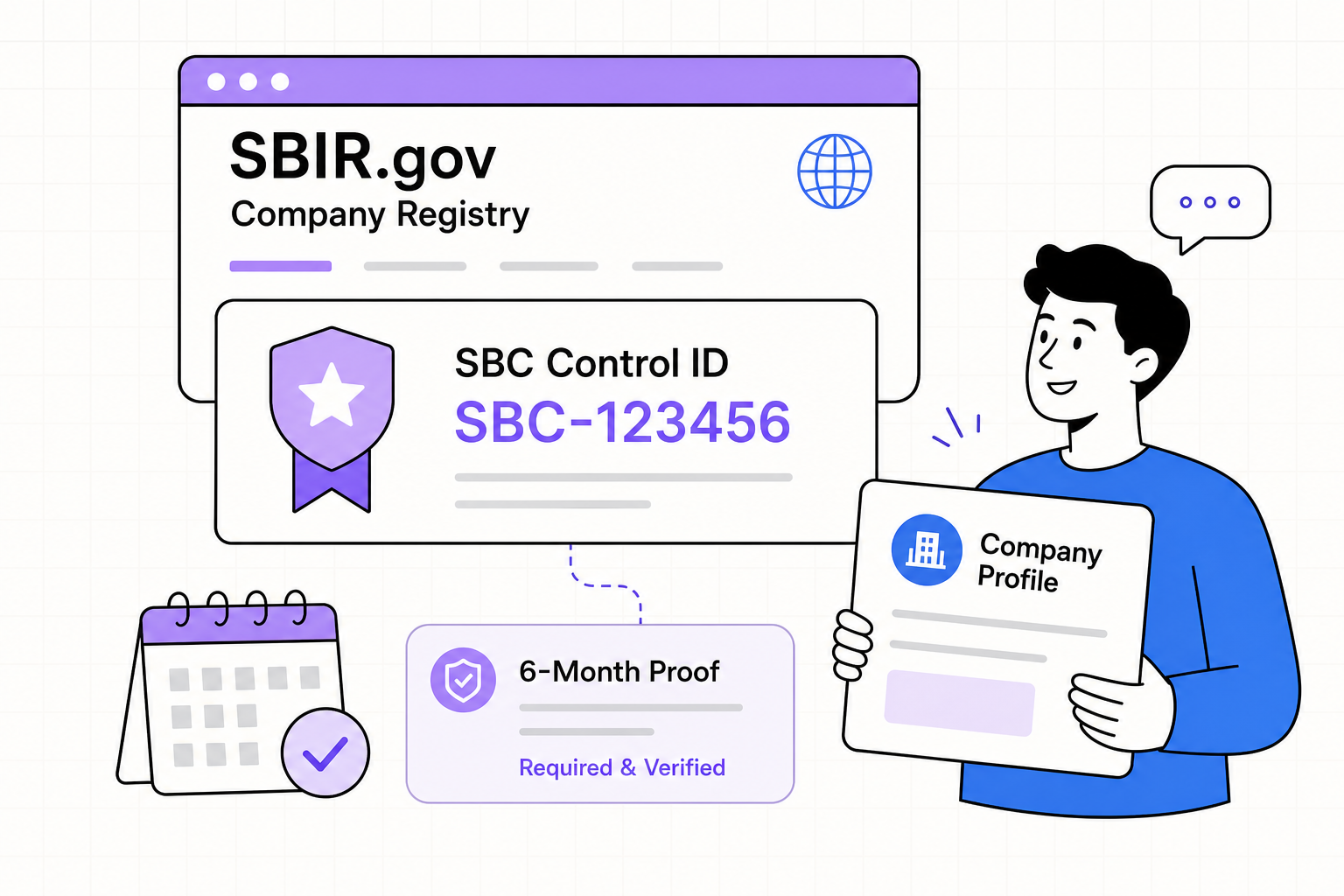
All SBIR and STTR applicants must register the company through SBIR.gov before submitting. A completed registration produces a unique SBC Control ID, a downloadable proof-of-registration document, and a company record used across participating agencies. This is separate from SAM.gov and from MySBA Certifications. Keep the proof current — update at least every six months.
- 1Create or sign in to your SBIR.gov account
Use an individual company-controlled email. Do not leave a former employee or consultant as the only administrator.
- 2Register or claim the company
Search before creating a duplicate. Match the legal identity shown in SAM.gov.
- 3Complete the company profile
Ownership, affiliates, institutional ownership, administrator, and contacts — accuracy matters.
- 4Obtain the SBC Control ID
Save it in the permanent registration record; you will associate it with proposals.
- 5Download proof and set a renewal reminder
Refresh whenever ownership, address, administrator, or affiliation changes — and at least every six months.
Optional MySBA certifications & Small Business Search
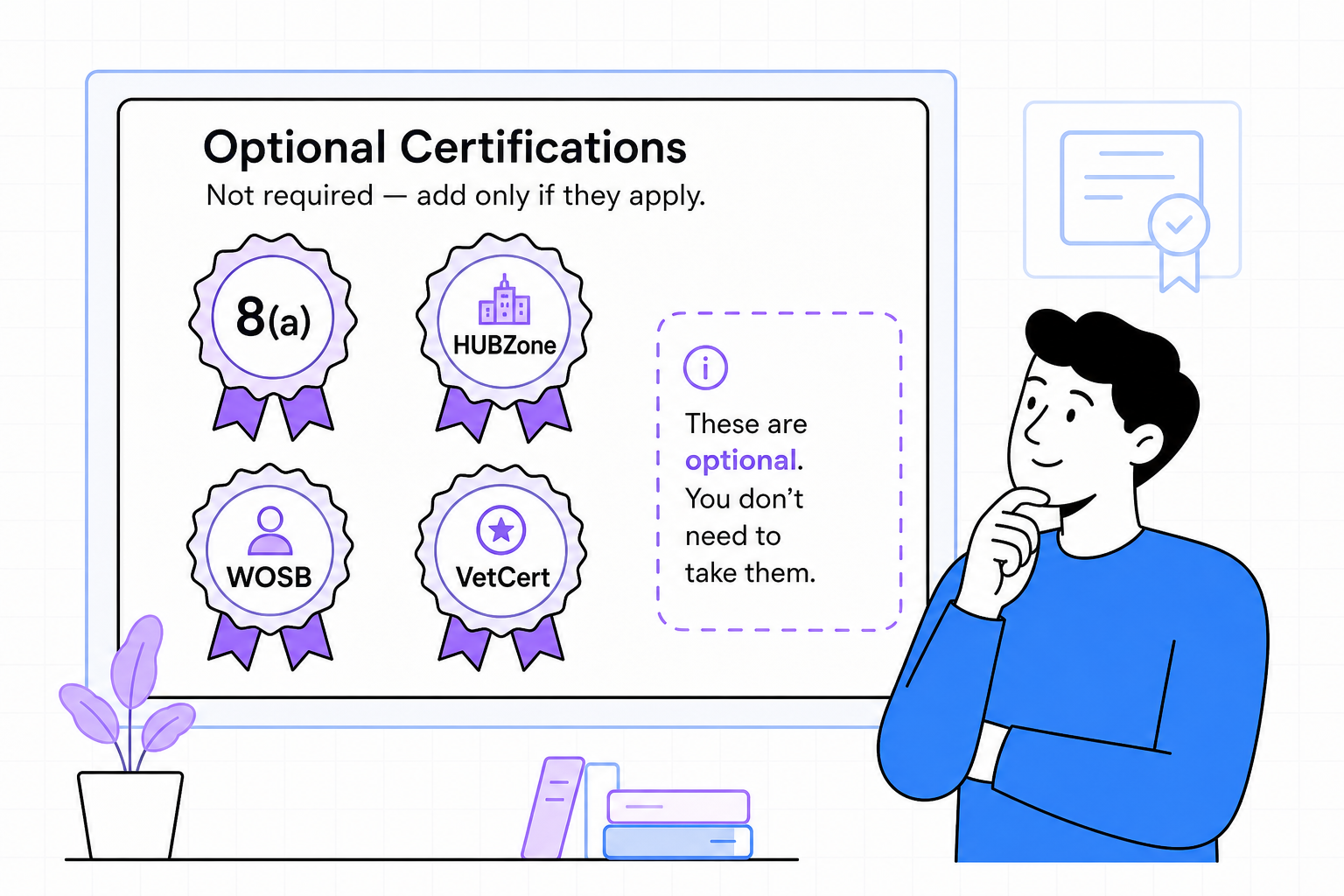
Socioeconomic certifications (8(a), HUBZone, WOSB/EDWOSB, VetCert VOSB/SDVOSB) can open set-aside and sole-source paths. They do not replace SBIR/STTR eligibility and are not generally required to submit a DSIP proposal. MySBA Certifications is the current central portal.
Business-development program for eligible socially and economically disadvantaged firms. Time-limited; not merely a badge; does not guarantee a contract.
Supports program-specific set-asides in designated NAICS. Does not create general SBIR eligibility.
HUBZone hinges on ownership, principal office, and employee residency you must maintain. VetCert covers VOSB/SDVOSB for qualifying federal (and VA) opportunities.
Small Business Search (formerly Dynamic Small Business Search) helps agencies and primes find you. Complete capability narrative, keywords, NAICS, geography, past performance, certifications, and contacts. Not required for DSIP — useful for market research and teaming.
SBIR vs STTR
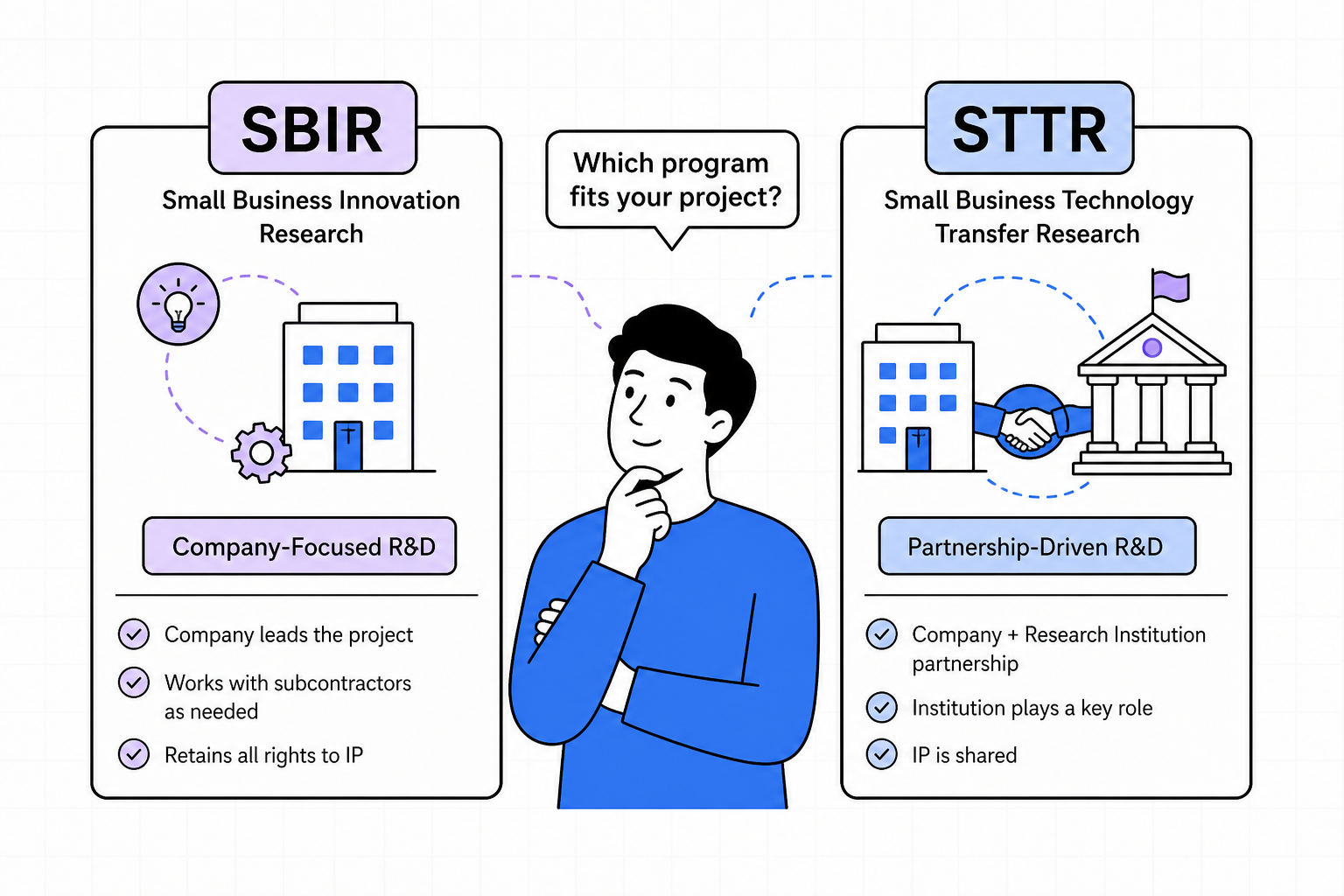
| Requirement | SBIR | STTR |
|---|---|---|
| Research-institution partner | Optional | Required |
| Small-business workshare | At least two-thirds in Phase I; one-half in Phase II | At least 40 percent |
| Research-institution workshare | No fixed minimum | At least 30 percent at one qualifying institution |
| Principal investigator | Primary employment generally with the small business | May be primarily employed by the small business or research institution |
| IP allocation agreement | Not the defining program requirement | Required between small business and research institution |
Phases I, II, D2P2, and III
Prove feasibility: technical merit, risk reduction, government relevance, and a credible path to Phase II.
Develop and demonstrate: prototyping, testing, integration planning, and commercialization / transition prep.
Direct to Phase II when the topic allows it and you can document Phase-I-equivalent feasibility that was not merely prior federally funded SBIR/STTR work — with sufficient rights to the technology.
Transition and commercialization using funding outside the SBIR/STTR program. Not a third competitive SBIR pool.
BAA vs CSO
SBIR/STTR is the program; BAA or CSO is the announcement method. Every opportunity can carry separate labels: program, phase, announcement type, component, and submission route (direct DSIP or xTech then DSIP).
Generally seeks scientific study, experimentation, basic or applied research to advance knowledge or the state of the art.
Competitive procedure focused on innovative commercial items, technologies, services, or new capabilities for a mission need. A CSO does not automatically mean an Other Transaction award.
Instruction hierarchy & the TPOC rule
A DSIP topic page is not the complete solicitation. Read layers in order: program-wide BAA/CSO → component instructions → topic and attachments → amendments → Topic Q&A → DSIP fields. Component instructions often supplement the program document and take precedence where they expressly conflict. Army instructions also require the DSIP firm profile to match SAM.gov.
DSIP setup — Login.gov, Firm Admin, PIN, roles
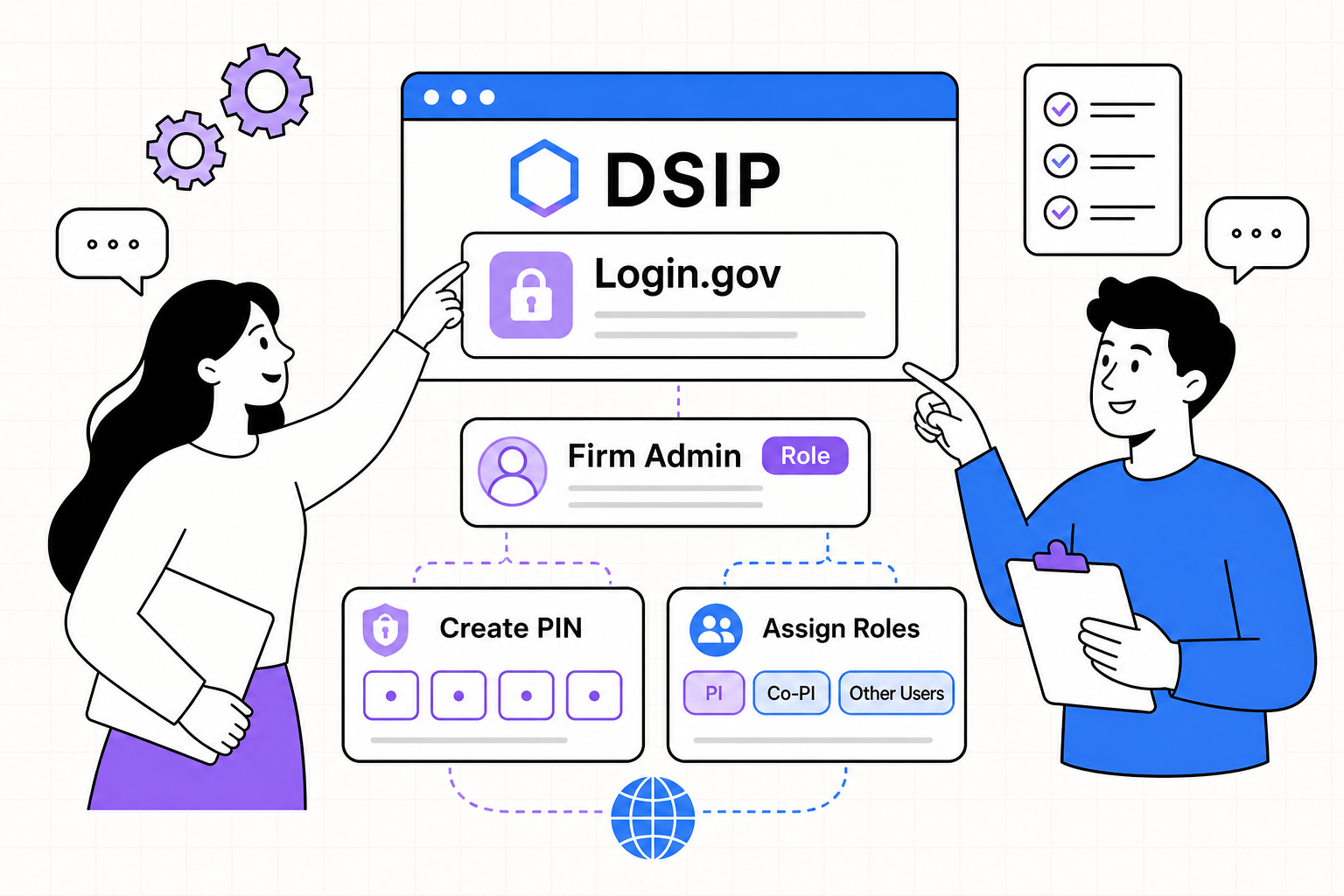
Defense requires SBIR/STTR proposals to be submitted electronically through DSIP. Users authenticate through Login.gov. Final submission requires firm forms, proposal volumes, and corporate certification.
- 1Create an individual Login.gov account
Account sharing is prohibited. Avoid group mailboxes for individual identities.
- 2Enter DSIP through its Login.gov flow
Start from DSIP — do not expect Login.gov alone to find your firm workspace.
- 3Find, create, or claim the firm record
Match SAM.gov legal name, DBA, UEI, CAGE, and physical address. Avoid duplicates.
- 4Identify Firm Admin and protect the Firm PIN
The company — not an outside consultant — should retain permanent control of Firm Admin and the PIN.
- 5Assign roles and complete firm forms early
Proposal Owner creates proposals; Corporate Official certifies and submits. Complete SBIR.gov info, CCR, certifications, foreign affiliation, and FWA training before crunch time.
Topic lifecycle
- 1Prerelease
Topics become visible; dates and instructions publish; start compliance work; TPOC contact generally permitted for clarification.
- 2Open
DSIP accepts proposals; direct TPOC contact ends; technical questions go to DSIP Topic Q&A; monitor amendments.
- 3Q&A cutoff
Technical-question deadline may be before proposal close — often about two weeks prior, but the active BAA/CSO controls.
- 4Close
No late proposals for account problems. “In Progress” or “Ready to Certify” is not submitted. Reopened proposals must be certified and submitted again.
The seven DSIP proposal volumes
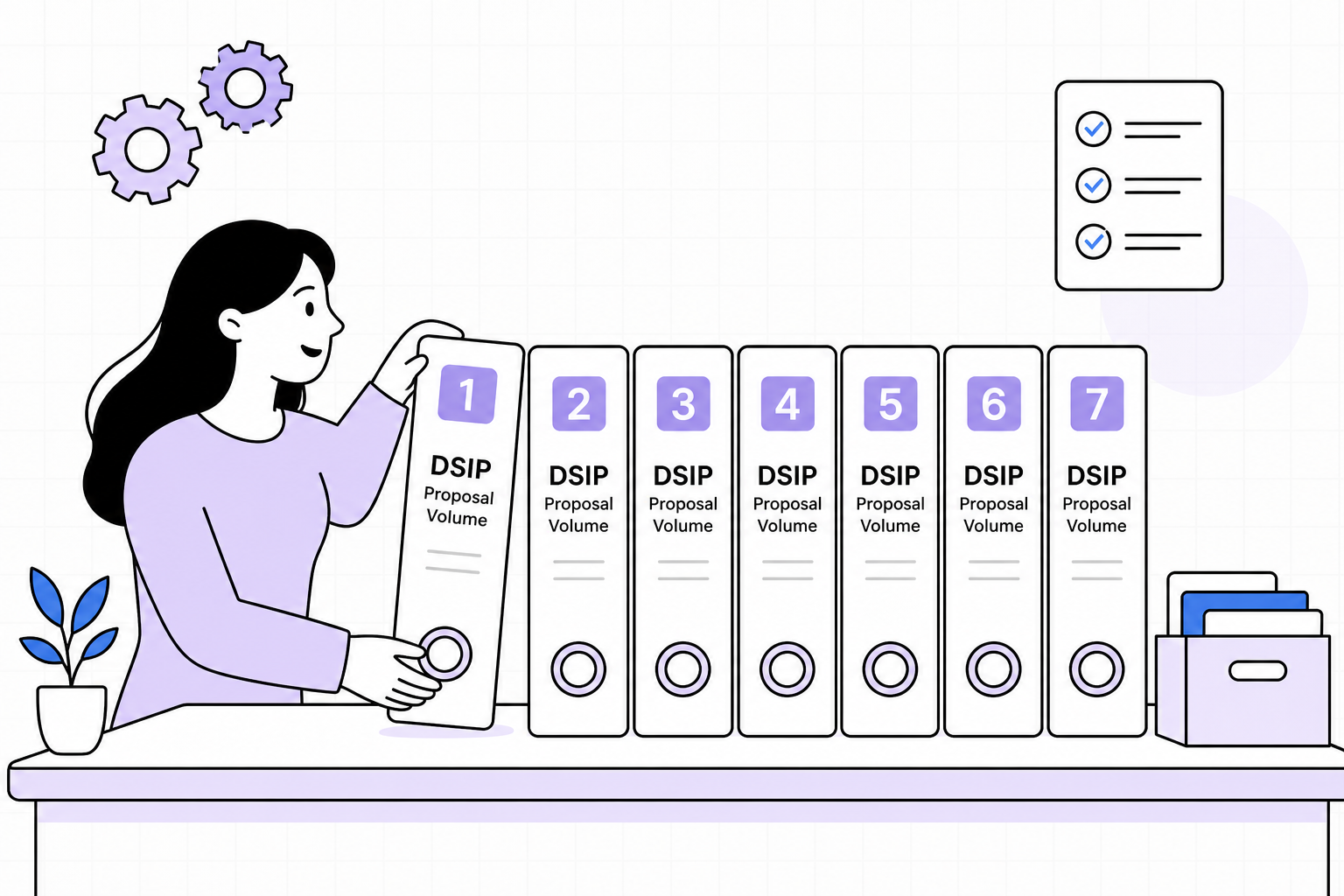
- Volume 1 — Proposal Cover Sheet (topic, title, firm, PI, abstract, cost, representations)
- Volume 2 — Technical Volume (approach, work plan, risks, team, transition — page limits vary)
- Volume 3 — Cost Volume (labor, indirects, materials, travel, subs, TABA, base/options)
- Volume 4 — Company Commercialization Report (historical CCR from SBIR.gov when required)
- Volume 5 — Supporting Documents (only what instructions require or permit)
- Volume 6 — Fraud, Waste, and Abuse Training (generally annual)
- Volume 7 — Foreign Affiliations and Relationships (current DSIP webform — not an obsolete PDF)
Backward-looking results from prior SBIR/STTR awards — sales, investment, Phase III outcomes — generated through SBIR.gov.
Forward-looking: how this technology reaches users and buyers. New firms may have empty CCR history and still need a strong strategy.
Foreign Risk Evaluation (FRE)
Following the 2026 reauthorization, Defense redesignated its SBIR/STTR due-diligence work as the Foreign Risk Evaluation (FRE) Program. It addresses foreign ownership, control, influence, affiliations, personnel, and technology transfer risks. Older training may still say “due diligence.”
Conditional requirements
These are not universal prerequisites for every SBIR proposal. Read the topic: STTR IP allocation agreements; export control / DD Form 2345 / JCP when controlled military technical data apply; cybersecurity (FCI/CUI, NIST SP 800-171, SPRS, CMMC) when clauses require them; human/animal subjects review; TABA vendor rules; organizational conflicts and duplicate funding; IP and data-rights assertions for background and developed technology.
Army xTech → Valid Eval → gated DSIP
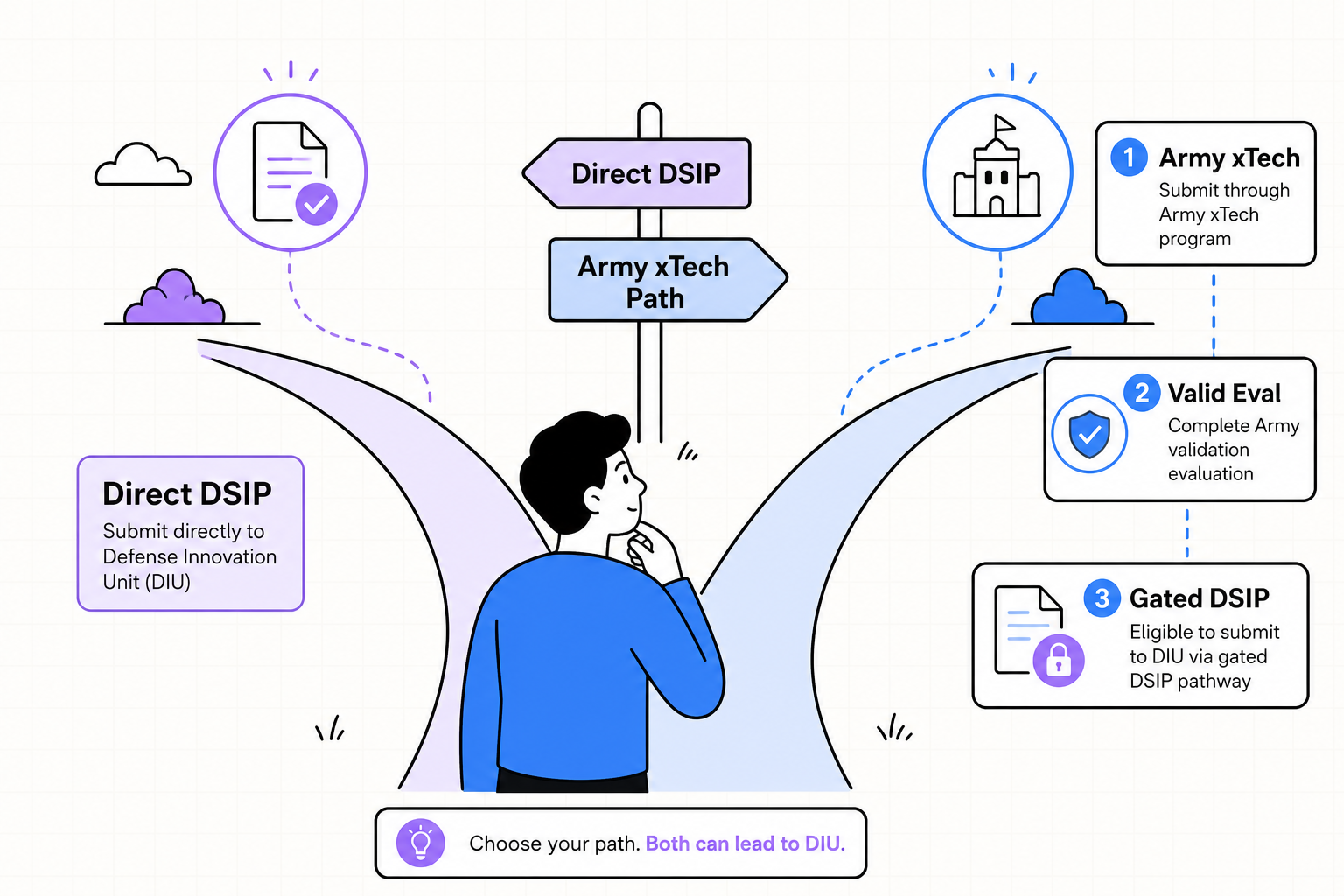
Find Army topic → read Defense and Army instructions → create proposal in DSIP → Corporate Official certifies and submits.
xTech competition → white paper via Valid Eval → pitch/demo phases → selected firms access a gated Army SBIR topic → full proposal through DSIP.
| Activity | System |
|---|---|
| Search Defense topics / submit full Defense SBIR/STTR | DSIP |
| Submit an xTech first-round white paper | xTech through Valid Eval |
| Submit an invited xTech-linked Army SBIR | DSIP (gated topic) |
| Manage SBIR company registration | SBIR.gov |
| Apply for socioeconomic certification | MySBA Certifications |
Proposal-ready library & accounting readiness
Build a reusable secure folder for registrations, corporate docs, ownership/affiliates, SBIR.gov, DSIP firm forms, key personnel, past performance, commercialization, cost/accounting, partners, IP, foreign risk, cyber, export, and templates — before a topic opens.
You do not need a universal “DCAA certification” to create a DSIP account. You should still explain and support direct/indirect labor, fringe, overhead, G&A, materials, travel, subcontracts, unallowables, timekeeping, and project-level cost collection. Selected firms may face SF 1408 accounting-system information and detailed cost justification.
- Written timekeeping; employees record time by project
- Direct vs indirect separation and job-cost tracking
- Documented indirect allocation and unallowable segregation
- Receipt retention, ledger reconciliation, approval controls
- A named person responsible for government-contract accounting
Submit checklist & after selection
- SAM active; UEI/CAGE correct; DSIP firm matches SAM; SBIR.gov proof and SBC Control ID current
- Eligibility: ≤500 employees with affiliates; PI and workshare compliant; U.S. performance
- All instruction layers read; correct templates; page/cost/duration rules checked
- All seven volumes complete; costs agree; foreign disclosures and FWA done
- Status is Submitted (not merely Ready to Certify); confirmation archived; no post-submit firm edits that reopen proposals
Selection is not yet an award. Expect eligibility verification, FRE, responsibility and cost analysis, possible accounting review, negotiation, IP/security/export review, and funding confirmation. Do not begin reimbursable work until an authorized contracting official issues the award. Performance is controlled by the contract — not the original topic page.
Common mistakes
- Believing SAM.gov automatically registered you for SBIR
- Treating 8(a)/WOSB/HUBZone/SDVOSB as an SBIR requirement
- Ignoring affiliate employees under the 500-employee limit
- Duplicate SBIR.gov or DSIP firm records; DSIP profile that does not match SAM
- Skipping component instructions; assuming DSIP validation equals compliance
- Contacting the TPOC after the open period; confusing CCR with commercialization strategy
- Leaving proposals Ready to Certify; forgetting to resubmit after a reopen
- Assuming xTech white papers go through DSIP or that a prize guarantees an SBIR award
- Claiming CMMC/export/accounting readiness you cannot document; proposing IP you do not control
You are proposal-ready

You are ready to pursue a first Defense SBIR/STTR topic when SAM, eligibility, SBIR.gov (SBC Control ID + current proof), DSIP firm setup and roles, basic accounting, IP awareness, foreign-risk records, commercialization strategy, templates, and a documented submission process are all in place.