
SBIR vs STTR
Eligibility, principal investigator rules, workshare, research partners, and when each program fits.
Before you begin
Confirm the shared eligibility baseline (U.S. place of business, ≤500 employees with affiliates, ownership/control) before choosing SBIR vs STTR.
Why this matters
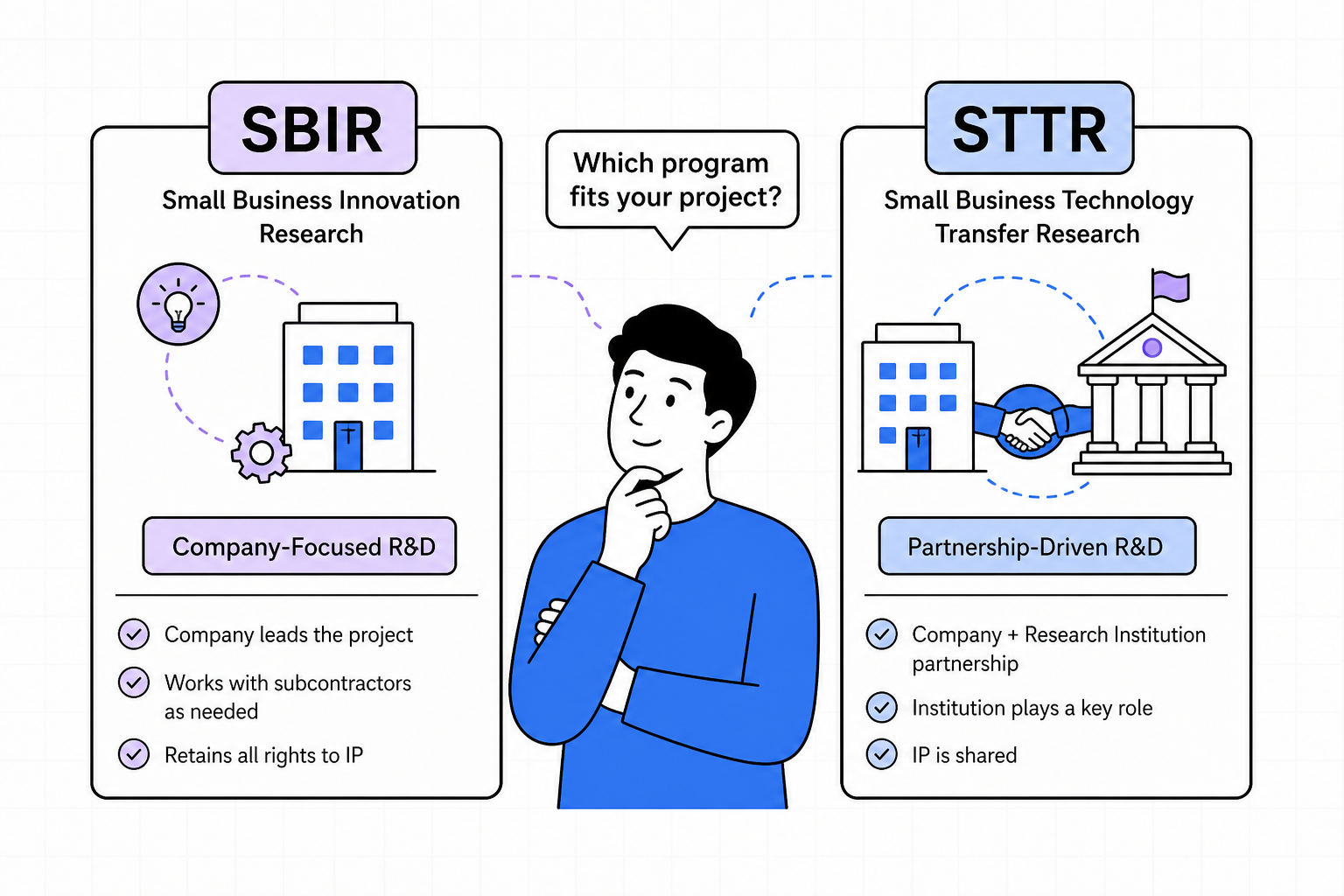
SBIR and STTR both fund small-business R&D — but the partner, workshare, and principal investigator rules differ. Choosing the wrong structure (or labeling a university subcontract as “STTR” without meeting the rules) can make a proposal noncompliant.
Side-by-side requirements
| Requirement | SBIR | STTR |
|---|---|---|
| Research-institution partner | Optional | Required |
| Small-business workshare | At least two-thirds in Phase I; one-half in Phase II | At least 40 percent |
| Research-institution workshare | No fixed minimum | At least 30 percent at one qualifying institution |
| Principal investigator | Primary employment generally with the small business | May be primarily employed by the small business or research institution |
| IP allocation agreement | Not the defining program requirement | Required between small business and research institution |
Phases I, II, D2P2, and III
Prove feasibility: technical merit, risk reduction, government relevance, and a credible path to Phase II.
Develop and demonstrate: prototyping, testing, integration planning, and commercialization / transition prep.
Direct to Phase II when the topic allows it and you can document Phase-I-equivalent feasibility that was not merely prior federally funded SBIR/STTR work — with sufficient rights to the technology.
Transition and commercialization using funding outside the SBIR/STTR program. Not a third competitive SBIR pool.
Topic instructions control award amounts, period of performance, and whether D2P2 is allowed. Always read the active BAA/CSO and component instructions — not a blog summary.
How to decide
- 1Map the work
Who will perform each WBS element? Where will R&D happen? Who employs the PI?
- 2Check partner necessity
If a research institution must own a large share of the technical work and you need a formal IP allocation agreement, STTR may fit.
- 3Check PI employment
SBIR generally expects primary employment at the small business. STTR is more flexible — confirm the active rules for your agency.
- 4Confirm workshare math
Build the budget so small-business and (if STTR) institution percentages clear the floors after any subcontracts.
You can choose a structure
- You know whether a research-institution partner is required for your path
- PI employment aligns with SBIR or STTR rules
- Draft workshare percentages clear the program floors
- If STTR: IP allocation agreement is on the critical path
- Phase (I / II / D2P2) matches topic eligibility