
B2B Teaming Agreements, NDAs & SBIR Letters of Commitment
What NDAs, teaming agreements, Exhibit A, and letters of commitment are; the paper teams normally use; why the documents look the way they do; how large-company proposal shops work (and where the PropShop name comes from); and how SBIR letters of commitment fit the picture.
Read this first
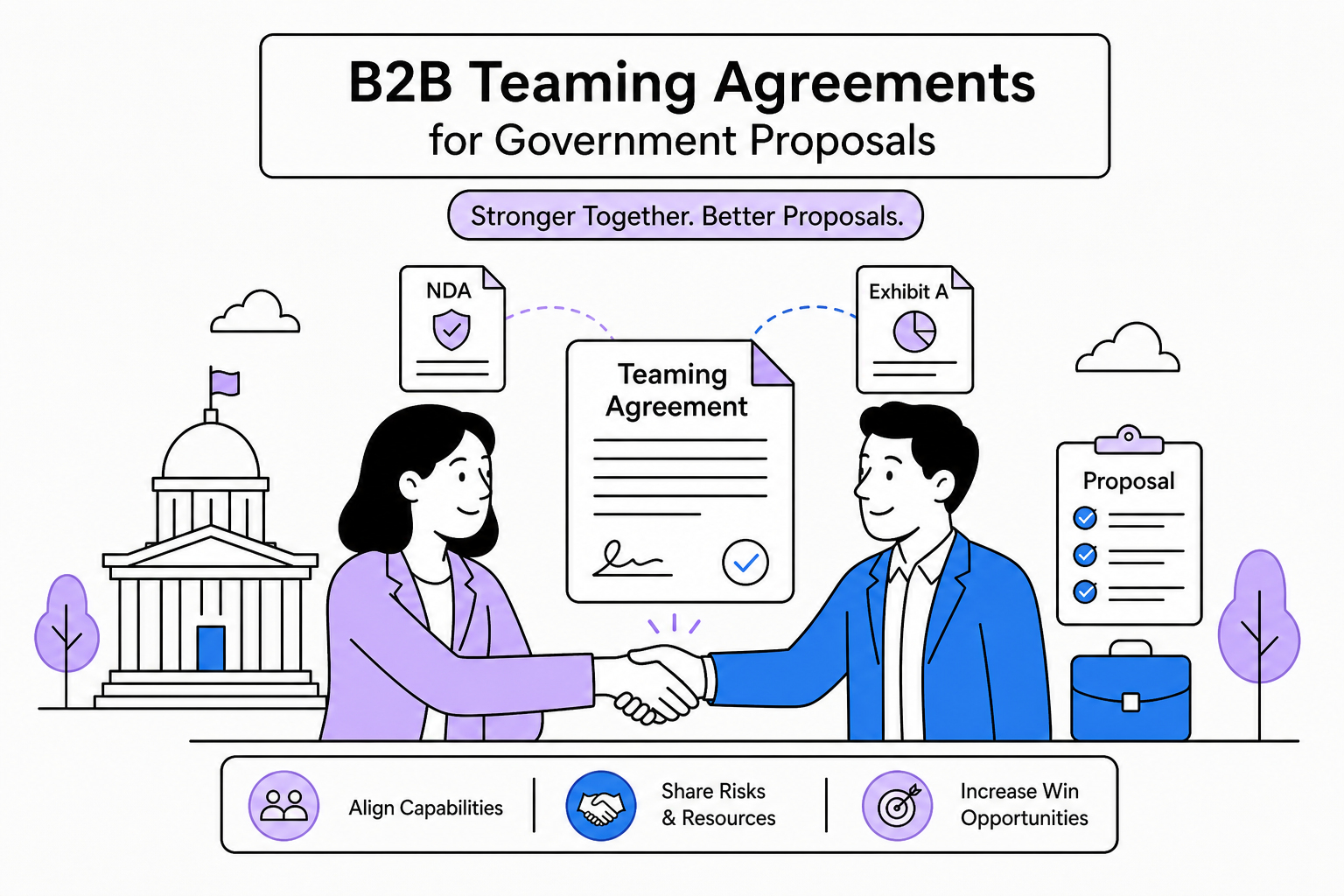
Federal pursuits rarely stay single-company for long. You share ideas under an NDA, lock roles under a teaming agreement, attach a detailed Exhibit A so nobody argues about workshare later, and — for many SBIR/STTR proposals — collect letters of commitment so evaluators can see that partners will actually show up.
- Know which instrument you need (NDA vs teaming vs subcontract vs letter)
- Use mutual NDA before deep technical exchange when both sides will share
- Put workshare, interfaces, and pricing hooks in Exhibit A — not in hallway talk
- Get SBIR letters of commitment early enough to survive corporate signature cycles
- Do not confuse a teaming agreement with an awarded subcontract
What they are — the four instruments
A non-disclosure (or confidential disclosure) agreement. It lets parties exchange proprietary information for a defined purpose without granting a license or committing anyone to bid. Usually first paper on the table.
A pursuit-phase contract that says how companies will chase a specific opportunity together: exclusive or non-exclusive, who is prime, workshare intent, proposal duties, and what happens if the team wins (or loses).
Post-award (or late-stage) purchasing paper. It creates enforceable performance, flowdowns, and payment. A teaming agreement is not a subcontract — do not treat a TA signature as authority to invoice.
A short signed letter (sometimes called letter of support / letter of intent) that a partner will contribute people, facilities, data, or purchase intent if the proposal wins. Common in SBIR Volume packages and transition narratives.
| Instrument | Primary job | Typical timing |
|---|---|---|
| NDA | Protect shared information | Before deep tech / cost talks |
| Teaming agreement | Lock pursuit roles & workshare intent | After go/no-go, before proposal freeze |
| Exhibit A (to TA or subcontract) | Define the actual work package | With the TA; refresh before award |
| Letter of commitment | Evidence for evaluators / transition | Draft early; sign before submit |
| Subcontract | Buy performance after (or near) award | Negotiation → kickoff |
What paper do teams normally use?
There is no single “government form” for B2B teaming. Large primes and sophisticated small businesses keep preferred templates. Smaller shops often start from counsel paper, an association template, or the other party’s form — then negotiate the few clauses that actually matter.
- 1Mutual NDA (short form)
2–6 pages. Mutual confidentiality, purpose limitation (e.g. “evaluating a teaming opportunity for [solicitation]”), term (often 2–5 years), residuals/residuals carve-outs if used carefully, and return/destruction. Avoid unilateral NDAs when both sides will share IP.
- 2Teaming agreement (opportunity-specific)
Often 8–20 pages plus exhibits. Names the solicitation/BAA/topic, exclusivity, prime designation, proposal responsibilities, workshare percentages or SOW slices, IP ownership for background vs foreground, OCI awareness, termination, and a path to negotiate a subcontract if awarded.
- 3Exhibit A — Statement of Work / workshare
The attachment people actually fight over. Tasks, interfaces, deliverables, labor mix, facilities, data rights assumptions, and rough price or cost-share. See the deep section below.
- 4Letter of commitment / support
1–2 pages on letterhead. Who, what they commit, period, any contingencies (“subject to award of…”), signature block with title. For SBIR, keep it specific enough to be believable and short enough to survive page budgets if attached.
- Correct legal names and addresses matching SAM / formation docs
- Named opportunity (solicitation number, topic, agency) — avoid evergreen “all DoD work” exclusivity by accident
- Exclusivity scope and duration you can actually honor
- Clear prime / sub intent and proposal lead
- IP: background stays with owner; foreground rules stated
- Signature authority (officer / authorized signatory) — not a random BD email
Why do they look like that?
Teaming paper looks dense because it is trying to do three jobs at once: protect secrets, allocate pursuit labor, and create a bridge to post-award subcontracting — without promising the government anything the companies cannot later perform.
| Clause you keep seeing | Why it exists |
|---|---|
| Purpose / “Evaluation only” | Stops the NDA from becoming a free license to use IP forever |
| Exclusivity | Stops partners from shopping the same solution to rival teams on the same bid |
| No partnership / no agency | Avoids accidental joint-venture tax, liability, or binding the other company |
| Proposal ownership | Clarifies who owns the submitted package and residual materials if the team dissolves |
| Best efforts / no guarantee of award | Honest: a TA is not a funded contract |
| Flowdown awareness | Reminds parties that FAR/DFARS clauses will appear in the real subcontract later |
| OCI / conflict representations | Protects both sides if advisory work or prior contracts create a conflict |
| Termination for convenience of pursuit | Lets a team kill a chase without pretending it was a breach of an award |
Exhibit A — deep guide
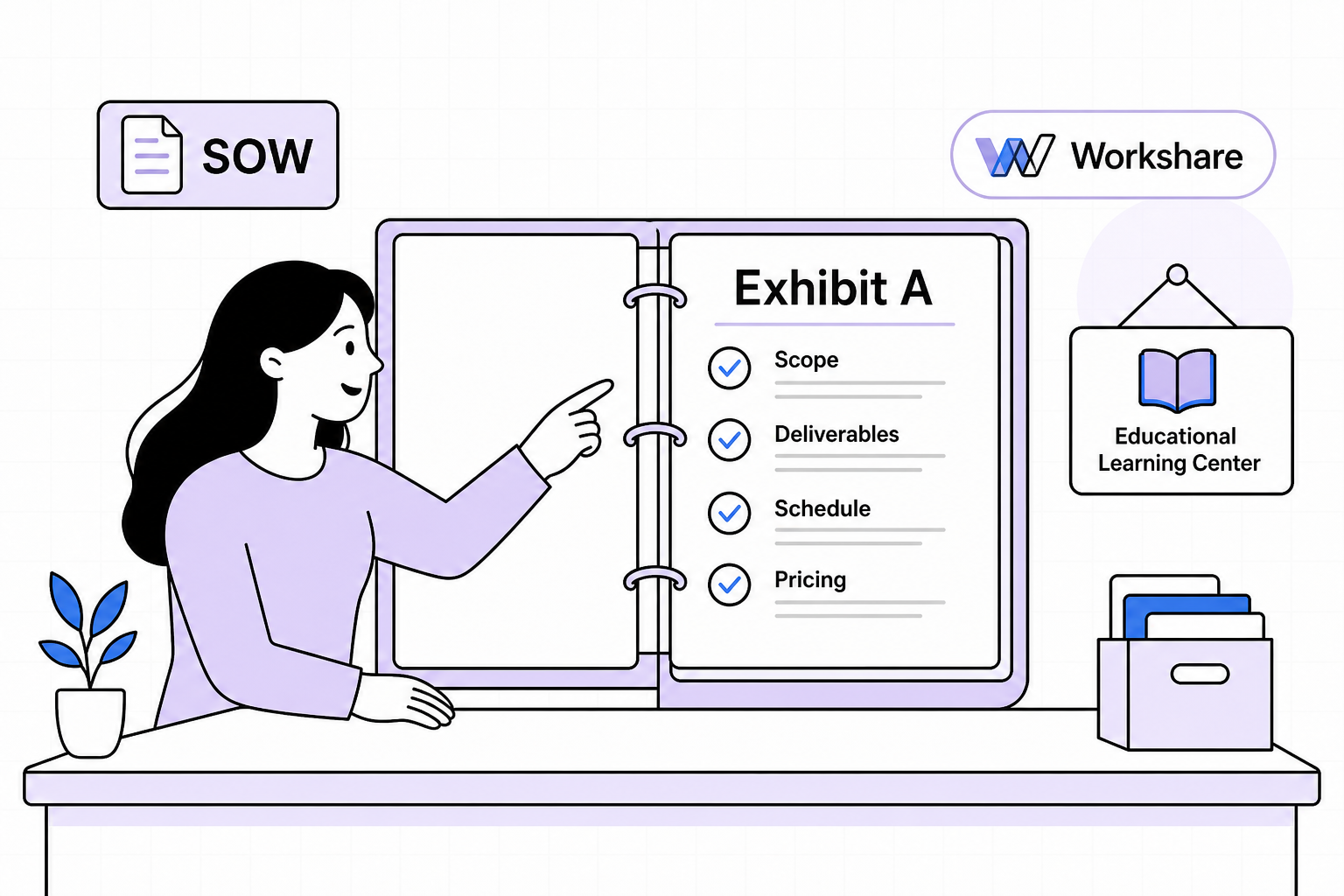
Exhibit A is where vague “we’ll help on the sensor” becomes an auditable work package. If the teaming agreement is the marriage license, Exhibit A is the chore chart — and most post-award fights started here as wishful thinking.
- 1Scope the slices, not the slogans
List concrete WBS-style tasks (e.g. “design and fabricate brassboard RF front-end,” “run 12 environmental test hours,” “draft Volume 2 Section 3”). Avoid “support as needed.”
- 2Define interfaces
Who owns the API, ICD, data format, hardware connector, and meeting cadence? Bad interfaces create duplicate work and silent gaps.
- 3Name deliverables and acceptance
What is due by proposal day vs after award? Drafts, CAD, test data, reports, software baselines. Note who accepts and in what format.
- 4State workshare math
Percentages of labor, cost, or clearly carved SOW value. For SBIR, remember small-business performance percentages and research-institution rules on STTR — Exhibit A should not invent a structure the solicitation forbids.
- 5Price hooks without fake precision
ROM, notional rates, or “to be negotiated in good faith within X days of award notice” are common. Do not invent certified cost or pricing data you do not have.
- 6IP and data assumptions
Background IP stays with the owner. Foreground developed under the future award follows the subcontract and the solicitation’s data-rights scheme — do not promise “unlimited rights to customer” in Exhibit A unless counsel agrees.
- 7People and facilities
Key personnel (if any), cleared spaces, labs, IT environments. If export-controlled data will move, say who holds JCP/DD2345 and who is Data Custodian — do not invent compliance you lack.
| Exhibit A element | Weak version | Stronger version |
|---|---|---|
| Task | “Help with electronics” | “Design, fab, and bring-up of 2 brassboard boards meeting ICD-Rev B by T0+90 days” |
| Workshare | “Roughly half” | “~35% of Volume 3 labor dollars; owns Tasks 3.1–3.4 in SOW” |
| Deliverable | “Inputs to the proposal” | “Final redlined Volume 2 §4 (≤8 pages) + BOM draft by freeze date” |
| Dependency | (none) | “Prime provides ICD and sample data by calendar date X” |
Proposal shops, Shipley, LONG Capture — and the PropShop name
Inside large aerospace and defense primes, “the prop shop” (proposal shop) is the standing organization that runs competitive responses: calendars, color-team reviews, compliance matrices, volume leads, production, and leadership gates. The name prop-shop.ai comes from that industry shorthand — a modern shop for finding, tracking, responding, and capturing work — not from retail storefronts.
Widely taught opportunity lifecycle: qualify, capture plan, win themes, ghosting competitors, compliance, and review gates (Pink/Red/Gold). Many company playbooks are Shipley-influenced even when they do not say the brand name.
LONG Capture and other commercial capture/proposal methodologies package training, templates, and coaching for the same problem: repeatable pursuit discipline. Plenty of boutique firms and internal “centers of excellence” do the same job under local names.
You do not need a 40-person shop. You do need a freeze date, a compliance matrix, a single owner for each volume, and written teaming paper before the scramble. That is the portable core.
- Partner list with role (prime / sub / university / vendor / customer LOC)
- NDA status column (sent / signed / expired)
- TA + Exhibit A status before proposal freeze
- LOC tracker for SBIR Volume attachments
- One owner who can say “this signature is late” without drama
Letters of commitment for SBIR / STTR
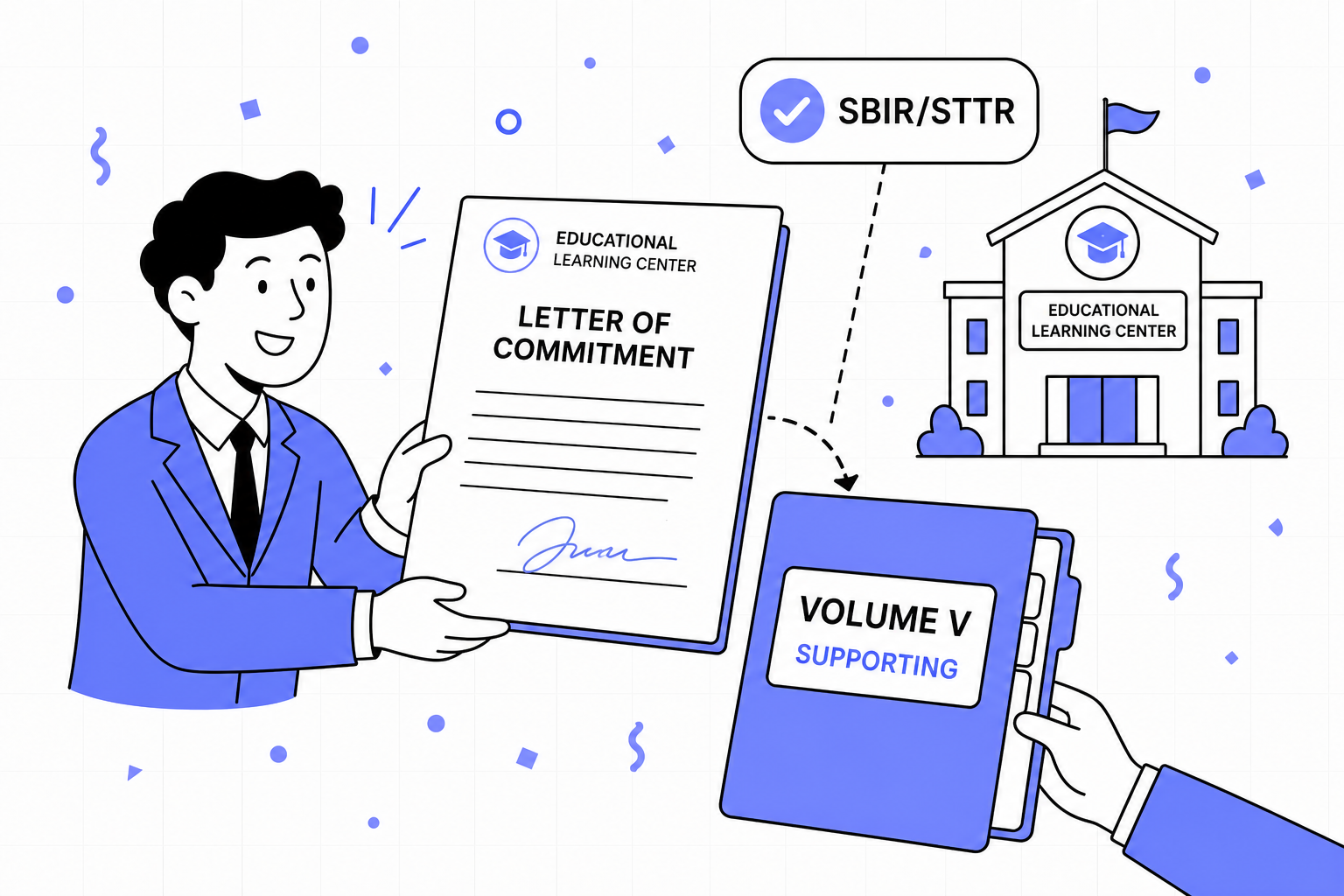
Defense SBIR/STTR proposals often need evidence that research partners, facilities, or transition customers are real. A letter of commitment (LOC) — sometimes labeled letter of support or letter of intent — is the short signed instrument that carries that evidence into the volume package.
| Letter type | Usually says | Watch-outs |
|---|---|---|
| Research partner LOC | Lab access, PI time, specific tasks if awarded | Must match STTR allocation / subcontracting rules |
| Facility / equipment LOC | Access to tools, ranges, compute, special test gear | Export-control and scheduling constraints |
| Transition / customer LOC | Interest in Phase II/III use, pilot, or purchase path | Do not overclaim a funded procurement that does not exist |
| Vendor / consultant LOC | Availability of key skills or TABA-style help | Keep cost story consistent with Volume 3 |
- 1Ask early — corporate signature is slow
Large labs and primes can take weeks for letterhead approval. Start LOC collection when you decide to bid, not the night before DSIP corporate certify.
- 2Write specificity without overpromising
Name the solicitation/topic, the contribution, the period, and “subject to award / subject to mutually acceptable subcontract.” Avoid blank “we support innovation” fluff.
- 3Align to Exhibit A and cost
If the letter promises 0.2 FTE of a named PI, Volume 3 and Exhibit A should not invent a different story.
- 4Store signed PDFs as proposal artifacts
Keep the final signed scan with the same care as Volume files. Resubmits and protests are ugly without the original.
Practical playbook (company-agnostic)
- 1Day 0–2 — Speak safely
Mutual NDA. Exchange only what the purpose clause allows. Mark proprietary pages.
- 2Day 3–10 — Decide roles
Go/no-go. Draft Exhibit A workshare. Choose prime. Open TA redlines on exclusivity, IP, and termination.
- 3Day 7–21 — Sign and staff
Execute TA + Exhibit A. Launch LOC requests in parallel. Put signature status on the proposal calendar.
- 4Freeze → submit
Lock volume text to the paper you actually signed. Do not describe a teammate you cannot evidence.
- 5If awarded
Convert Exhibit A into subcontract SOW quickly. Flow down clauses. Kick off against the real instrument — not the TA.